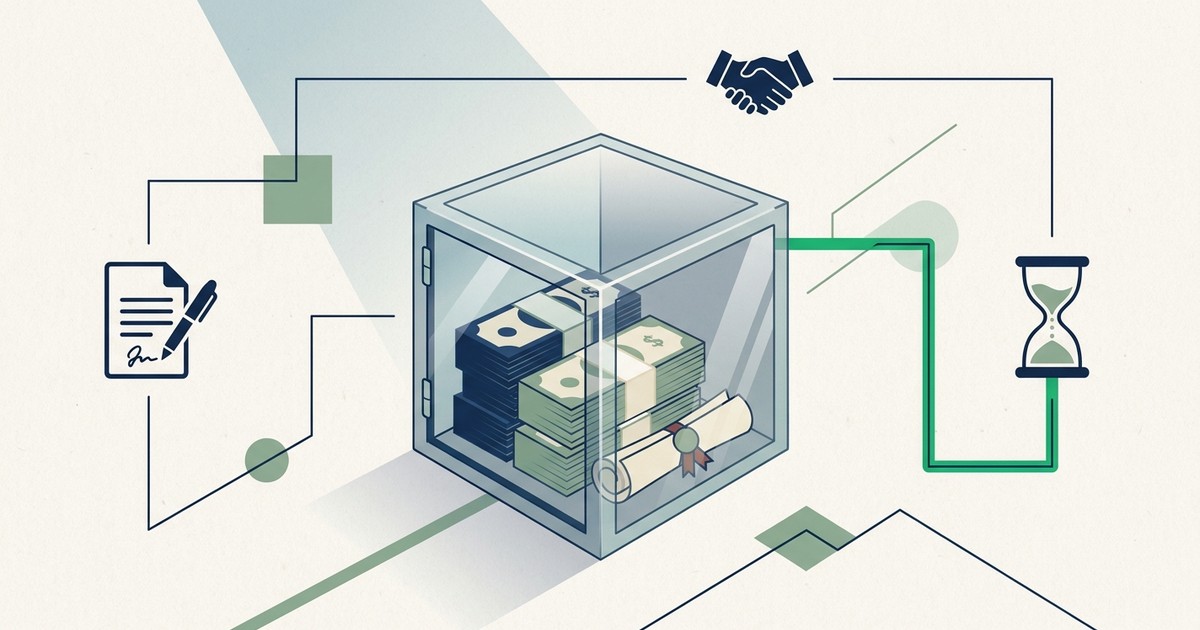
A founder signs the term sheet for the sale of his company at a $42 million enterprise value. The buyer is a US-listed acquirer, the deal is “all cash at completion,” and the founder spends the weekend doing the maths on what each shareholder will receive. On Monday his lawyer emails him the first draft of the share sale agreement and asks him to focus on clause 14 — the escrow and indemnity clause. The buyer wants 15% of the purchase price held back for 24 months in a law firm trust account, with a separate 5% holdback for “fundamental” warranties surviving for seven years. The founder reads it twice. He has just discovered that roughly $8.4 million of his headline price is contingent on something other than the deal closing.
This is the part of an exit that founders consistently underestimate. The headline number captures everyone’s attention; the escrow and holdback architecture is where the real economic transfer happens. Two deals with identical $42 million enterprise values can deliver dramatically different outcomes to founders and early employees depending on how the post-completion protection package is drafted. Founders who do not understand this end up surprised — sometimes years after they thought the deal had closed — by claims, set-offs and locked-up cash that erode the proceeds they had already mentally allocated.
What Escrow and Holdbacks Actually Do
An escrow is a third-party-held pool of money — typically a law firm trust account or specialist escrow agent — set aside from the purchase price to satisfy claims the buyer may have against the sellers after completion. A holdback is the same idea expressed differently: instead of paying the seller the full purchase price and clawing it back if a claim arises, the buyer keeps a defined portion and pays it out only if no claim is made within the agreed period. Functionally they do the same job; mechanically the buyer’s recourse is easier with an escrow because the cash is already segregated.
The purpose is to back the seller’s warranties (factual statements about the company — that it owns its IP, has filed its tax returns, has no undisclosed litigation) and indemnities (specific promises to pay for identified known or anticipated risks — usually tax, specific contract issues, pre-completion employment claims). If a warranty turns out to be false, or an indemnified event eventuates, the buyer can claim against the escrow rather than chase the sellers individually.
The Numbers That Actually Get Negotiated
There is no Australian “market” for escrow size in the way that there is for US technology M&A, but the typical band sits between 5% and 15% of the purchase price, with the precise figure driven by deal size, sector risk, and the quality of due diligence. Startup acquisitions where the buyer has done deep IP and tax diligence often land at the lower end; deals with messy cap tables, regulatory exposure, or large customer contracts pull toward the upper end.
Duration is the second negotiation. General warranties typically survive 12 to 24 months, which is the period during which the escrow is held. Tax warranties are usually carved out and survive much longer — often until the end of the statutory amendment period under the Income Tax Assessment Act 1936 and related legislation (so up to seven years for some items, longer for fraud). Fundamental warranties (title to shares, capacity, due incorporation) often survive indefinitely, or for the relevant limitation period under the Limitation Act 1969 (NSW) and equivalents.
The third axis — and the one founders most often miss — is the cap and basket. The cap is the maximum the sellers can be required to pay in total; commonly equal to the escrow amount for general warranties, and up to 100% of the purchase price for fundamental warranties and tax. The basket is a minimum threshold below which claims cannot be made. A well-drafted basket should be a deductible (only losses above the threshold are recoverable) and not a tipping basket (where exceeding the threshold makes the entire amount claimable from the first dollar). Founders should also negotiate a de minimis — a per-claim minimum below which individual matters cannot be aggregated into the basket at all.
Warranty and Indemnity Insurance: The Trade
Over the last decade, warranty and indemnity (W&I) insurance has shifted from a tool used only in large private equity transactions to a mainstream feature of Australian mid-market M&A — and increasingly of mid-sized startup acquisitions. The deal is straightforward: a third-party insurer underwrites the warranties and indemnities, and the buyer claims against the policy instead of against the sellers’ escrow. In exchange, the escrow shrinks dramatically (often to 0.5% to 1% of price, just enough to sit beneath the insurance retention) and the warranty cap that the sellers carry effectively collapses.
For founders, W&I is almost always the right structure if the buyer will accept it and the deal size justifies the premium (typically 1.0%–1.5% of policy limit, with a minimum premium that makes deals below roughly $20 million uneconomic). The premium is often paid by the buyer, who values the clean economics; even where the seller pays, the premium is usually a fraction of the cash that would otherwise be locked up in escrow for two years. The founder negotiation is not “do we want W&I” but “do we get the buyer to procure it and is the deal big enough to make the premium economic.”
Where the Seller’s Cash Actually Lives
In a clean Australian deal, the typical end-state for the seller-side cash flow looks like this. Cash on completion is wired to the sellers’ nominated accounts in proportion to their shareholding. The escrow amount is held by an independent stakeholder under an escrow deed. Any earn-out — additional purchase price contingent on post-completion performance — is governed by a separate set of mechanics, sometimes secured by escrow, sometimes by guarantee, sometimes left as a buyer covenant. A purchase price adjustment (typically working capital or net debt true-up) sits separately again, often resolved 60–90 days after completion. Each pool has its own release mechanics, its own dispute procedure, and its own risk profile. Founders should ensure they understand which money sits where, and what triggers release of each.
Five Practical Points Founders Get Wrong
The escrow is the cap in substance, not just the security. If the sellers’ liability is capped at the escrow amount for general warranties (the usual position), then the escrow is the maximum exposure. Negotiating a smaller escrow is therefore a negotiation about your downside, not just your cash flow.
Joint and several liability matters more than the cap. Where multiple founders sell, the buyer almost always wants joint and several liability among them. That means if one founder is unreachable or insolvent, the others pick up the whole bill — up to the cap. Push hard for several liability proportionate to consideration received, with the escrow as the only joint pool.
Disclosure beats negotiation. Anything fairly disclosed in the disclosure letter generally cannot be the subject of a claim. The biggest reduction in real exposure comes from comprehensive, well-drafted disclosure — not from arguing the cap down.
Earn-out cash is at the buyer’s discretion in operational substance. Even with covenants requiring the buyer to operate the business in good faith, founders who depend on earn-out cash to make the deal work are taking real risk. Treat any earn-out as upside; the deal must work on the cash at completion plus the escrow you expect to recover.
The escrow agent is not a judge. Escrow agents (usually a law firm trust account) release funds only on joint instructions or a court order. Plan the dispute resolution mechanic carefully — expert determination on quantum, with a fast track for undisputed claims, is materially better than full arbitration.
What Founders Should Do
Negotiate the package, not the headline. Size, duration, cap, basket, de minimis, several liability, and W&I together drive the real economics. Trading two points on the cap for joint-and-several can be a worse outcome than the reverse.
Front-load disclosure. Build the disclosure letter as a substantive document, not a formality. Every well-drafted disclosure shrinks the live claim universe.
Bring W&I into the conversation early. If the deal size supports it, raise W&I at term sheet stage and structure the escrow assuming W&I is in place.
Model the actual cash. Build a table for each founder showing completion cash, escrow expected to release, earn-out at base/upside/downside cases, and PPA adjustments. Sign nothing until the worst-case number is one you can live with.
The Bottom Line
The headline price of a startup acquisition is the deal everyone celebrates; the escrow and holdback architecture is the deal you actually live with. Founders who understand the relationship between escrow size, warranty caps, basket mechanics, W&I insurance, and several liability negotiate exits that deliver what the term sheet promised. Founders who do not — and there are many — discover the gap between signed and received months after the champagne has gone flat.
Viridian Lawyers advises Australian startup founders and acquirers on M&A transactions, share sale agreements, and the post-completion protection mechanics that determine what an exit actually delivers. If you are negotiating a sale and want to think through the escrow and warranty package, get in touch.