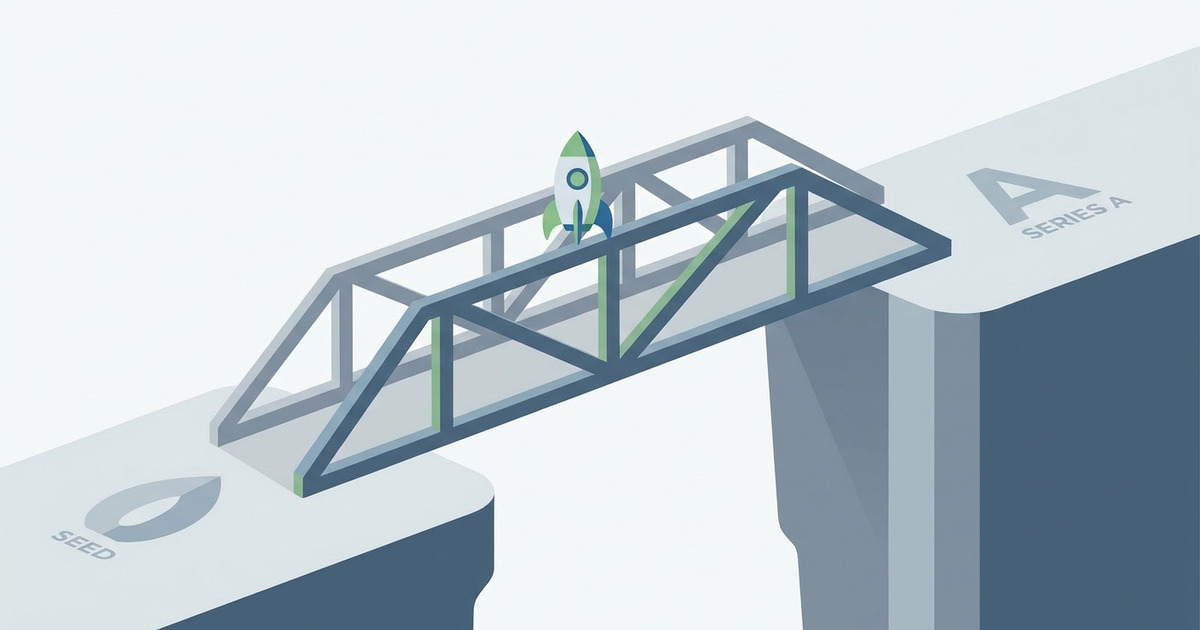
Not every fundraise goes according to plan. Markets shift, milestones take longer than expected, or the metrics are not quite where they need to be for a Series A or B. When a startup needs more runway but is not ready for a full priced round, two options dominate the conversation: bridge rounds and extension rounds. Both can keep the company alive and growing, but they carry different legal mechanics, signalling effects, and risks that founders need to understand before signing anything.
Bridge Rounds vs Extension Rounds: What Is the Difference?
The terms are often used loosely — and sometimes interchangeably — but they describe different things.
A bridge round is new interim funding designed to carry the company to a specific future event, typically the next priced equity round. Bridge rounds usually involve convertible instruments — either convertible notes or SAFEs — and are often led by existing investors. The idea is that the money “bridges” the gap between where the company is today and where it needs to be to raise on better terms.
An extension round reopens the terms of the most recent priced round and allows existing or new investors to invest additional capital on substantially the same terms. If you raised a Series Seed at a $10 million post-money valuation, an extension round might reopen that Seed on identical or near-identical terms. The company issues more shares of the same class at the same price.
The practical distinction matters. Bridge rounds signal that the company is between milestones and needs time to get there. Extension rounds signal that the company is performing well enough that existing terms still make sense — it just needs more capital to accelerate. The legal structures reflect that difference.
Common Instruments for Bridge Rounds
Australian startups typically use one of three instruments for bridge financing:
Convertible Notes
A convertible note is a debt instrument that converts into equity upon a qualifying event — usually the next priced round above a specified threshold. Key terms include:
- Valuation cap: The maximum valuation at which the note converts, protecting the bridge investor if the next round values the company highly.
- Discount rate: Typically 15–25%, giving the note holder a discount to the next round’s price per share.
- Interest rate: Because convertible notes are debt, they accrue interest. In Australia, this is usually 5–10% per annum, and the accrued interest converts alongside the principal.
- Maturity date: The date by which the note must convert or be repaid. If the company has not raised a qualifying round by maturity, the note holder may have the right to demand repayment or convert at a pre-agreed valuation.
Under the Corporations Act 2001 (Cth), convertible notes are regulated as debentures under Chapter 2L. However, most startup convertible note issues rely on disclosure exemptions in section 708 — particularly the small-scale offering exemption (section 708(1)), the sophisticated investor exemption (section 708(8)), or the professional investor exemption (section 708(11)). These exemptions avoid the need for a prospectus, but they come with caps and conditions that founders must track carefully.
SAFE Notes
A SAFE (Simple Agreement for Future Equity) is not debt. It is a contractual right to receive equity upon a future qualifying event. SAFEs have no maturity date, no interest rate, and no repayment obligation. They convert when the company raises a priced round, is acquired, or undergoes certain other trigger events.
In Australia, SAFEs based on the Y Combinator template have been adapted to comply with Australian law. The key terms mirror convertible notes — valuation cap and discount rate — but without the debt mechanics. For bridge financing, SAFEs are attractive because they are simpler and faster to execute. No loan agreement, no interest calculations, no maturity default risk.
The regulatory position of SAFEs under Australian law is less settled than convertible notes. They are generally treated as financial products, meaning the same section 708 disclosure exemptions apply. But because SAFEs are not debt instruments, they do not trigger the debenture provisions in Chapter 2L. Founders should ensure their SAFE template has been reviewed by Australian counsel — the US template does not account for Australian regulatory requirements.
Priced Bridge Equity
Less commonly, bridge rounds are structured as small priced equity rounds — issuing a new class of preference shares with terms that sit between the previous round and the anticipated next round. This is more complex and expensive to document but can be appropriate where the investor wants immediate equity rights (voting, information, board observer) rather than waiting for conversion.
How Extension Rounds Work
Extension rounds are mechanically simpler. The company reopens the most recent round and issues additional shares of the same class on the same terms. In practice, this means:
- Same share price and class. The extension uses the same price per share and preference share terms as the original round.
- Same shareholders’ agreement. New investors in the extension typically accede to the existing shareholders’ agreement by signing a deed of accession.
- Same cap table impact. Because the price is the same, the dilution calculation is straightforward — no conversion mechanics, no caps, no discounts.
Extensions work best when the original round was recent (within the last 6–12 months), the company’s trajectory supports the original valuation, and the existing investors are supportive. They are particularly common in the seed stage, where the difference between a $3 million raise and a $4.5 million raise might simply be a matter of bringing in one more fund.
The legal documentation for an extension is usually light: a board resolution authorising the additional share issue, an updated subscription agreement (or a short-form top-up agreement), and a deed of accession to the shareholders’ agreement. If the terms are genuinely identical, the negotiation is minimal.
Key Legal Issues Founders Should Watch
Whether you are raising a bridge or an extension, several legal issues deserve careful attention.
Cap Table Complexity
Bridge rounds using convertible instruments add a layer of contingent equity to your cap table. Until the notes or SAFEs convert, you do not know exactly how many shares they will produce — that depends on the valuation and terms of the next round. This creates uncertainty for future investors doing due diligence and can complicate cap table modelling.
Multiple overlapping convertible instruments — say, an original seed SAFE plus a bridge convertible note with different caps — compound this problem. Each instrument converts independently based on its own terms, and the interaction between them can produce unexpected dilution. Keep a detailed conversion waterfall model and update it with every new instrument.
Existing Investor Consent
Most shareholders’ agreements include anti-dilution protections, pre-emptive rights, and consent requirements for new share issues. Before issuing bridge or extension instruments, check whether existing investors have pre-emptive rights that need to be offered or waived. In many cases, bridge rounds are led by existing investors exercising or waiving these rights, but if you are bringing in new money, the consent mechanics matter.
For extension rounds, some shareholders’ agreements restrict the number of shares that can be issued in a particular class without investor approval. If the original round authorised 1 million Series Seed shares and you have already issued them all, you may need a shareholder resolution to authorise additional shares.
Signalling Risk
A bridge round from existing investors — particularly if the amount is small relative to the original round — can signal to the market that the company is struggling. New investors evaluating a future Series A will ask why the company needed interim financing and whether existing investors are merely protecting their position rather than expressing genuine confidence.
Extensions carry less stigma because they imply the company is performing well enough that the original terms remain fair. But an extension that significantly increases the round size without clear justification can raise similar questions.
Founders should be prepared to articulate a clear narrative: what the bridge or extension capital will achieve, what milestones it unlocks, and why the timing makes sense.
Conversion Mechanics and the Next Round
For bridge rounds using convertible instruments, the conversion mechanics at the next priced round are where most disputes arise. Key questions include:
- What counts as a qualifying financing? Most notes and SAFEs define a minimum raise threshold — say, $2 million in new money — below which the instruments do not convert. If the next round comes in below that threshold, the instruments remain outstanding.
- Does the bridge convert before or after the new round’s pre-money valuation is calculated? This affects dilution. If bridge instruments convert into the pre-money cap table, existing shareholders bear more dilution. If they convert into the post-money, the new round investors share the dilution.
- What happens on an acquisition before conversion? Most instruments include acquisition payout provisions — typically a multiple of the invested amount (1x to 2x) or conversion at the cap, whichever is greater. These provisions can create unexpected obligations on exit.
Tax Implications
In Australia, the tax treatment of convertible notes and SAFEs differs. Convertible notes accrue interest, which creates a taxable income obligation for the note holder and a potential deduction for the company. SAFEs, because they are not debt, do not have this characteristic — but their tax classification is less clear-cut, and the ATO’s position continues to evolve.
For extension rounds, the tax position is simpler: the company issues shares at a set price, and standard CGT and ESS rules apply. Founders should obtain tax advice before issuing any new instruments, particularly if the investor base includes overseas participants where withholding obligations may arise.
Practical Tips for Founders
Move quickly. Bridge rounds should close in two to four weeks. If negotiation drags on, the runway problem gets worse. Use a standard SAFE or convertible note template to minimise legal costs and negotiation time.
Keep the terms clean. Every additional sweetener — a lower cap, an extra discount, a warrant — adds complexity to your cap table and creates a precedent for future rounds. Simple terms convert cleanly.
Communicate with your board. Your existing investors should not be surprised by a bridge raise. Discuss runway projections early, explore whether existing investors will participate, and align on the narrative before approaching new capital.
Document everything. Even a $200,000 bridge note needs proper documentation — a convertible note agreement or SAFE, board resolutions, section 708 compliance records, and ASIC filings where required. Cutting corners on documentation creates problems at due diligence.
Model the dilution. Before signing any bridge instrument, model the conversion scenarios. What happens if the next round is at the cap? Below the cap? What if you need a second bridge? Understanding the dilution outcomes in advance gives you negotiating clarity.
The Bottom Line
Bridge rounds and extension rounds are pragmatic tools for managing runway, and most venture-backed startups will use one or both at some point. The difference between a bridge that buys time to succeed and one that entrenches problems often comes down to the legal terms, the investor dynamics, and the founder’s ability to execute on whatever the capital is meant to achieve. Get the structure right, keep the documentation clean, and make sure the next milestone is achievable — not aspirational — with the capital you are raising.