If you’ve ever spoken to a US venture capital firm about funding your Australian startup, you’ve probably heard some version of the same question: “Are you a Delaware C-Corp?”
If the answer is no — and for most Australian-founded companies, it will be — the next question is usually whether you’d be willing to “flip” to one. This process, known as a Delaware flip (or “flip-up”), is the corporate restructure that inserts a new US parent company between your existing Australian entity and its shareholders. It’s the standard playbook for Australian startups seeking serious US capital.
But a Delaware flip isn’t a simple form or a weekend project. It involves real legal complexity, significant tax considerations, and ongoing costs that founders need to understand before committing. Here’s what you need to know.
What Is a Delaware Flip?
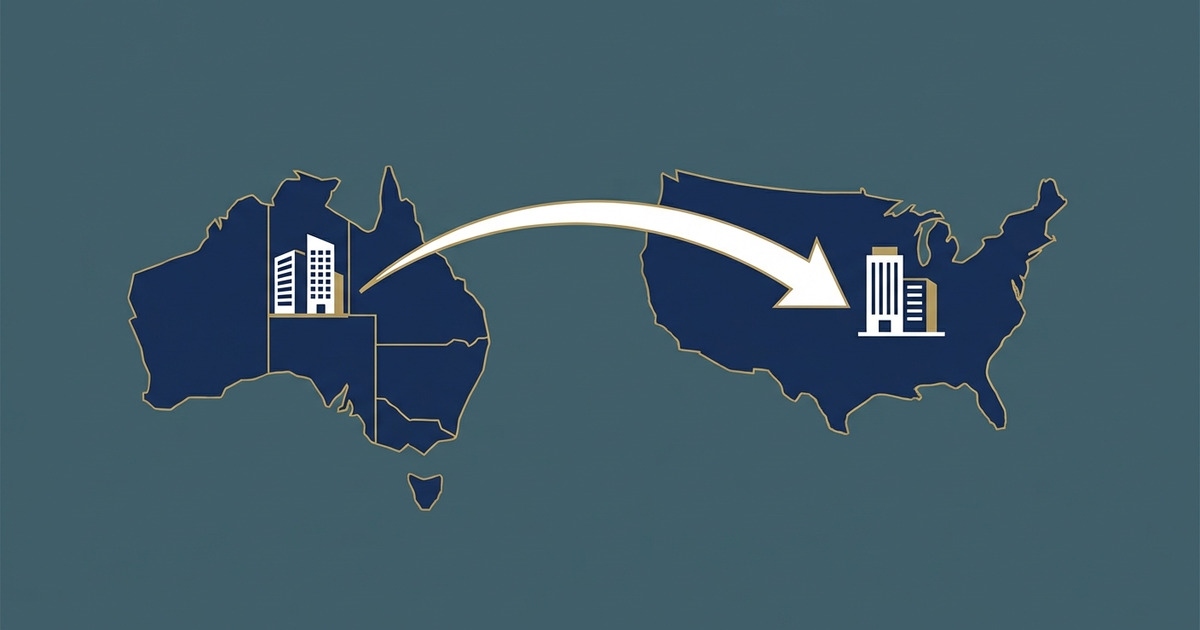
A Delaware flip is a corporate reorganisation where a new holding company — typically a C-Corporation incorporated in Delaware — is created and becomes the parent company of your existing Australian entity. The mechanics work like this:
- Form the US parent. A new Delaware C-Corp (“US TopCo”) is incorporated.
- Share exchange. Existing shareholders of the Australian company (“AusCo”) transfer their shares to US TopCo in exchange for newly issued shares in US TopCo, in the same proportions.
- Subsidiary structure. AusCo becomes a wholly owned subsidiary of US TopCo. The Australian business continues to operate through AusCo — the same ABN, the same employees, the same contracts.
- Securities migration. Any options (including ESOP), convertible notes, SAFEs, or warrants on issue in AusCo are cancelled and replaced with equivalent instruments in US TopCo.
After the flip, your investors and shareholders own the US parent, which in turn owns the Australian operating company. The Australian business doesn’t disappear — it just has a new owner sitting above it.
Why Do US Investors Want This?
The short answer: familiarity and tax efficiency.
US venture capital firms have spent decades investing through standardised Delaware structures. Their legal documents, governance expectations, and exit mechanics are all built around the Delaware General Corporation Law. Asking a US fund to invest directly into an Australian proprietary company means asking their lawyers to grapple with the Corporations Act 2001 (Cth), ASIC compliance, and a legal framework they may not have seen before. Most won’t bother — not when the next deal in their pipeline is already a Delaware C-Corp.
There’s also a powerful tax incentive. Under Section 1202 of the US Internal Revenue Code, investors in Qualified Small Business Stock (QSBS) can exclude up to 100% of their capital gains from federal tax if they hold shares in an eligible US C-Corp for more than five years. This exclusion — which can shelter up to $10 million or 10 times the adjusted basis per taxpayer — is a significant draw for US investors. An Australian company simply doesn’t qualify.
Some accelerator programs, including Y Combinator, also require participants to be structured as US entities. For Australian founders eyeing those ecosystems, a flip is table stakes.
When Should You Flip?
Timing matters. The universal advice from lawyers and VCs who work on these transactions is: flip early or flip in parallel with your raise, but don’t flip late.
The reasons are practical:
- Simpler cap table. An early-stage company with two founders and a handful of angel investors is far easier to restructure than a Series B company with multiple share classes, complex investor rights, and an extensive ESOP pool.
- Lower valuation. Although CGT rollover relief is usually available (more on that below), a lower company valuation at the time of the flip reduces complexity and risk if something goes wrong with the tax structuring.
- 100% participation required. Every shareholder must agree to exchange their shares. Even one holdout can derail the process. The fewer shareholders you have, the easier this is to manage.
That said, most founders won’t flip speculatively. The typical pattern is to flip immediately before or concurrently with a US-led funding round — when there’s a concrete reason to incur the cost and complexity.
The Tax Considerations
This is where founders need professional advice, not blog posts. But here are the key areas to understand at a high level.
Capital Gains Tax and Rollover Relief
When Australian shareholders exchange their AusCo shares for US TopCo shares, they’re technically disposing of a CGT asset. Without relief, this could trigger a capital gains tax liability — even though they haven’t received any cash.
Fortunately, scrip-for-scrip rollover relief under Subdivision 124-M of the Income Tax Assessment Act 1997 (ITAA 1997) may allow shareholders to defer that CGT event. If the conditions are met (including that US TopCo acquires at least 80% of AusCo’s shares), each shareholder can choose to roll over their capital gain, effectively deferring the tax until they eventually dispose of their US TopCo shares.
This relief isn’t automatic — it requires careful structuring and, in some cases, a private binding ruling from the ATO to confirm eligibility. Get your tax advisor involved early.
Tax Residency of the US Parent
Here’s a trap that catches many Australian founders. Under Australian tax law, a company can be an Australian tax resident if its central management and control is in Australia — regardless of where it’s incorporated. If all of US TopCo’s directors are in Australia and all board decisions are made from Sydney, the ATO may treat US TopCo as an Australian tax resident, which defeats much of the purpose of the restructure.
The practical solution is to ensure that US TopCo has genuine US-based management: at least one US-resident director, board meetings held in the US (or at least outside Australia), and decision-making that isn’t purely cosmetic. If the founders are all based in Australia with no plans to relocate, this requires careful governance design.
ESOP Restructuring
If AusCo has an existing employee share option plan, those options need to be cancelled and replaced with options over US TopCo shares. This can trigger tax consequences for participants under Division 83A of the ITAA 1997, particularly if the replacement options are treated as new grants rather than continuations of the original scheme.
Restructure relief may be available, but it’s technical and fact-specific. In some cases, you may need a private ruling from the Commissioner of Taxation.
What Does It Cost?
A straightforward Delaware flip typically costs in the range of AUD $40,000–$80,000, covering:
- Australian legal advice (corporate restructure, shareholder agreements, ASIC compliance)
- US legal advice (Delaware incorporation, US corporate governance documents)
- Tax and accounting advice (rollover relief structuring, transfer pricing, ongoing compliance)
That range assumes a relatively simple cap table with cooperative shareholders. Costs can escalate significantly if the company has multiple classes of shares, complex investor rights, convertible instruments, or shareholders who need individual advice.
There are also ongoing costs to maintain the structure: US federal and state tax filings, Delaware franchise taxes (modest for early-stage companies), a registered agent in Delaware, and the added complexity of running financial reporting across two jurisdictions. Budget an additional AUD $10,000–$20,000 per year in compliance costs.
If you’re flipping concurrently with a raise, these costs are typically funded from the round proceeds.
The Practical Downsides
A Delaware flip isn’t all upside. Founders should weigh several considerations:
- Dual jurisdiction complexity. You’re now operating under both Australian and Delaware law. That means two sets of corporate governance obligations, two regulatory regimes, and higher legal costs on an ongoing basis.
- US litigation environment. The US is more litigious than Australia. Depending on your industry, being a US-domiciled company may expose you to risks you didn’t face as a purely Australian entity.
- Irreversibility. A flip-up is extremely difficult to unwind. Once you’ve restructured, you’re committed to the US parent structure for the foreseeable future.
- Loss of Australian incentives. Some Australian government grants and tax incentives (including the R&D Tax Incentive and the Early Stage Innovation Company tax offset) may be affected if the Australian entity is no longer the ultimate holding company. Check eligibility carefully before flipping.
- ASIC reporting. After the flip, AusCo becomes a subsidiary of a foreign company. Under the Corporations Act, this can trigger enhanced reporting obligations — AusCo may be treated as a “large proprietary company” regardless of its actual size, requiring audited financial statements and directors’ reports unless specific ASIC relief is obtained.
Should You Flip?
Not every Australian startup needs a Delaware flip. If you’re raising from Australian VCs, or your target market is primarily domestic, the costs and complexity are hard to justify. Australian venture capital has matured significantly, and local investors are perfectly comfortable with Australian corporate structures.
A flip makes sense when:
- You’re raising (or plan to raise) from US-based VCs who require or strongly prefer a Delaware structure
- Your primary market is the US and you intend to build significant operations there
- You’re joining a US accelerator that requires US incorporation
- Your exit strategy contemplates a US trade sale or US listing
The decision should be driven by commercial reality, not aspiration. “We might raise from the US one day” is not a sufficient reason to incur the cost and complexity of a flip. “We have a term sheet from a US fund that requires it” is.
Getting It Right
A Delaware flip touches corporate law, tax law, employment law, and securities regulation across two jurisdictions. It requires coordination between Australian and US lawyers, tax advisors, and accountants — and it requires every single shareholder to participate.
Done well, it positions your company to access the deepest pool of venture capital in the world. Done poorly, it creates tax liabilities, governance headaches, and a structure that’s expensive to maintain and nearly impossible to reverse.
If you’re considering a flip — or a US investor has asked you to — get in touch. We work with Australian startups on cross-border restructures, from initial structuring advice through to execution.